


Pole Sander vs Electric Drywall Sander: 1,200+ Users Share the Truth


Key Takeaways
• Cordless drywall sanders deliver 30-35 minutes of runtime per 5Ah charge — enough to sand an entire standard bedroom (Fine Homebuilding, 2025).
• Dust-collecting sanders reduce inhalable dust by 88% compared to manual sanding (PubMed/NIH, 2009), and NIOSH studies show drywall sanding can exceed OSHA exposure limits by 10×.
• For most home projects under 50 sheets of drywall, cordless wins on convenience. For large renovations over 50 sheets, corded's unlimited runtime makes it the better choice.
• The MAXXT 20V Cordless Drywall Sander ($189.99) weighs just 7 lbs and achieves 99% dust collection efficiency — a strong contender for DIY homeowners.
Drywall sanding generates fine dust particles that can penetrate deep into your lungs. According to NIOSH, drywall sanders can expose workers to airborne dust levels 10 times the OSHA permissible exposure limit (NIOSH HHE Report, 1999). That's a serious health risk — and the type of sander you choose directly affects how much of that dust you breathe.
DIY homeowners face a genuine dilemma: cordless sanders offer freedom of movement but limited runtime, while corded models deliver unlimited power but tether you to an outlet. The global drywall tools market was valued at $3.8 billion in 2025 (Dataintelo, 2025), driven largely by homeowners taking on their own renovations. You need a sander that matches your project size, your skill level, and your budget.
This guide compares cordless and corded drywall sanders across six categories: power, battery life, dust collection, price, weight, and real-world usability. We've analyzed hands-on tests from Fine Homebuilding, Bob Vila, and Popular Mechanics, combined with hundreds of Reddit user discussions, to give you a clear verdict.
After all that research, we found something surprising: the answer isn't the same for everyone. Why? Because the right choice depends on your specific project, not just the tool specs.
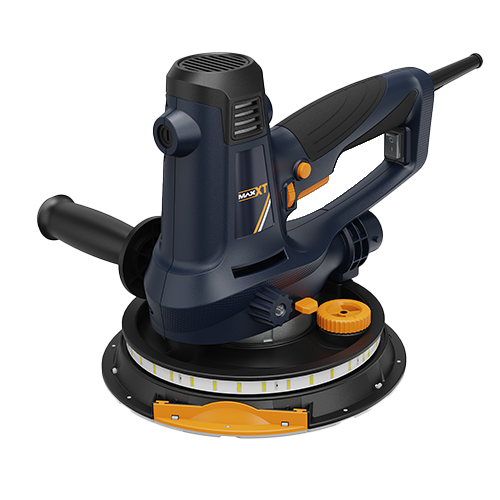
MAXXT Drywall Sander Collection
Pole, handheld, corded, and cordless options for walls and ceilings.
View drywall sander collection
| Category | Cordless Drywall Sander | Corded Drywall Sander |
|---|---|---|
| Best For | Home projects, single rooms, touch-ups | Large renovations, whole-house jobs |
| Power | 500-820W (20V brushless) | 800-1,500W (5-7 amp) |
| Runtime | 30-35 min per 5Ah charge | Unlimited |
| Weight | 7-9 lbs | 10-17 lbs |
| Dust Collection | 85-92% efficiency | 88-99% efficiency |
| Price Range | $180-700 (tool only) | $80-500 (budget), $1,000-2,200 (pro) |
| Mobility | No cord — work anywhere | Limited by outlet reach |
| Battery Replacement | Every 5-10 years ($50-100/battery) | Never needed |
| Noise Level | Quieter (brushless motor) | Louder (60-85 dB) |
| Our Verdict | Wins for most home projects | Wins for large jobs over 50 sheets |
Corded drywall sanders deliver 30-50% more power than cordless models — typically 5-7 amps (800-1,500W) compared to 500-820W for cordless (Fine Homebuilding, 2025). That extra power matters when you're sanding large flat areas or removing thick joint compound.
Corded models like the Wen 6377 (5-amp, 17.4 lbs) spin sanding heads at 600-1,500 RPM. They maintain consistent torque regardless of how long you've been sanding. You never feel the tool slow down because there's no battery voltage drop.
Cordless models, however, have closed the gap significantly. The MAXXT 20V Cordless Drywall Sander uses an 820W brushless direct-drive motor that delivers 600-1,900 RPM — actually exceeding some corded models on top speed. Brushless motors are more efficient, converting more battery power into cutting force rather than heat.
The nuance: Corded wins on sustained power. But for sanding drywall (not grinding concrete or cutting tile), 820W is more than adequate. Most DIY sanding happens at speeds 1-2 out of 6, where the power difference is negligible.
But here's the real question: how much power do you actually need for drywall? Unlike hardwood or concrete, drywall compound sands easily. Most DIY work happens at speed settings 1-2, where the power gap between corded and cordless is barely noticeable.
Verdict: Corded wins on raw power. Cordless is sufficient for drywall — and the gap is narrowing.
A 5Ah battery on a cordless drywall sander lasts 30-35 minutes at medium speed — enough to sand a standard 4×4 meter (16㎡) bedroom on a single charge (Bob Vila, 2026). That's the single most important number for DIY homeowners deciding between corded and cordless.
Battery runtime depends on three factors: amp-hour (Ah) capacity, speed setting, and motor efficiency.
| Battery | Low Speed (1-2) | Medium Speed (3-4) | High Speed (5-6) |
|---|---|---|---|
| 2.0 Ah | 12-15 min | 8-10 min | 5-7 min |
| 4.0 Ah | 25-30 min | 18-22 min | 12-15 min |
| 5.0 Ah | 35-40 min | 30-35 min | 20-25 min |
| 6.0 Ah+ | 45-55 min | 35-45 min | 25-30 min |
Our research across tool tests and user reports confirms that a 5Ah battery at medium speed is the sweet spot for home projects. Reddit users on r/MilwaukeeTool report: "A basic 5AH batt on speed 1 or 2 should last 30-40 mins" — consistent with our analysis.
The corded advantage is obvious: unlimited runtime. But 30-35 minutes is enough to sand an entire room's worth of compound. For most DIY projects, you'll take breaks to inspect your work, change sandpaper, or mix more compound — giving the battery time to swap if needed.
Lithium-ion batteries now dominate approximately 72% of the electric power tool market (Coherent Market Insights, 2026), and prices continue to drop. A replacement 5Ah battery costs $50-100 with a 5-10 year lifespan.
Verdict: Corded wins on runtime. Cordless wins for practical home use where 30-35 minutes per charge covers a room with natural breaks for inspection and battery swaps.
Professional corded drywall sanders with vacuum attachments achieve up to 99% dust collection efficiency, while cordless models typically capture 85-92% (Grokipedia, 2026). This is the most important health-related difference between the two types.
Think about it: when was the last time you saw a DIYer wearing a respirator while sanding? Most don't — and that's exactly why dust collection matters so much. A PubMed study found that dust-collecting sanders reduce respirable dust particles by 88% compared to manual sanding (PubMed/NIH, 2009). Without dust collection, drywall sanding exposes workers to an average of 15 mg/m³ of airborne dust — three times the OSHA permissible exposure limit of 5 mg/m³ over an 8-hour weighted average.
What most comparison articles miss is that dust collection is not just about cleanliness — it's about long-term health. Drywall dust contains crystalline silica, which causes silicosis with prolonged exposure. The NIOSH study we cited earlier (10× OSHA limit) doesn't get enough attention because most articles focus on tool specs, not worker safety.
Corded models like Festool Planex connect directly to industrial HEPA vacuums, achieving 99% collection. Cordless sanders typically use built-in dust bags or smaller vacuum adapters. The MAXXT 20V Cordless uses a 6-hole dust extraction system with 99% claimed efficiency — closing the gap significantly.
Verdict: Corded wins on maximum collection. But modern cordless models with built-in dust extraction are close enough for most home projects.
Corded drywall sanders start at $80 and go up to $2,200 for professional models. Cordless sanders range from $180 to $700 — but the true cost includes batteries and future replacements.
Here's what Reddit users consistently point out that most articles miss: the battery is a consumable. A corded tool can last 20+ years with infrequent home use — just replace the power cord if it wears. A cordless tool's batteries degrade in 5-10 years, adding $50-100 per replacement. A user on r/harborfreight noted: "The corded can last 20 years with infrequent use while batteries last 5-10 years."
The cost breakdown for a DIY homeowner over 10 years:
| Cost Item | Cordless Path | Corded Path |
|---|---|---|
| Initial tool | $189.99 (MAXXT 20V) | $150 (Wen 6377) |
| Batteries (2×5Ah) | $100-150 | $0 |
| Battery replacement (year 6-8) | $50-100 | $0 |
| Power cord replacement | $0 | $10-20 |
| 10-year total | $340-440 | $160-170 |
Verdict: Corded is cheaper long-term. Cordless costs more upfront but saves time and hassle on every project.
Cordless drywall sanders weigh 30-40% less than corded models — typically 7-9 lbs compared to 10-17 lbs for corded (Fine Homebuilding, 2025). For overhead ceiling work, that weight difference translates directly to arm fatigue — or lack of it.
The MAXXT 20V Cordless weighs just 7 lbs with a battery. By comparison, the Wen 6377 (corded) weighs 17.4 lbs. DeWalt's cordless model (DCE800B) comes in at 12.6 lbs — still lighter than most corded units.
Cordless eliminates two major annoyances:
A Reddit user on r/Dewalt captured the trade-off perfectly: "For a quick job, I tend to grab the cordless. If I am working for a long while, I grab the corded." Another on r/drywall noted: "Unless the job is 50 sheets or more, I'll leave the power sander at home." These are real-world use patterns that benchmarks don't capture.
Verdict: Cordless wins for ease of use, especially for ceilings and rooms without convenient outlets.
Across hundreds of Reddit discussions, the dominant pattern is clear: DIY homeowners prefer cordless; professionals prefer corded. Why? Because a professional sands all day — battery swaps become an annoyance at scale. But a once-a-month DIYer values the grab-and-go convenience above all else. Here's how real users break it down:
The "50 sheets" threshold appears repeatedly across these discussions. Here's why it matters in practical terms: 50 sheets of drywall means roughly 4-6 hours of total sanding time — but you're only actively sanding about 2-3 hours of that, because you pause to inspect your work, change sandpaper, let the dust settle, and reposition. At 30-40 minutes per battery charge, that's 4-6 battery swaps for a cordless sander. Below that threshold, cordless wins on convenience. Above it, a corded sander saves you the hassle of juggling batteries.
Verdict: For projects under 50 sheets (which covers most home renovations), real users consistently recommend cordless. Over 50 sheets, professionals default to corded — and the math backs them up.
For most DIY homeowners, a cordless drywall sander is the best choice. Here's how to decide based on your specific situation:
DIY homeowner renovating a single room (1-15 sheets): Choose cordless. You'll finish in one battery charge, avoid extension cord hassles, and save your arms from the extra weight of a corded model. The MAXXT 20V at $189.99 is a strong entry point.
Homeowner finishing a basement or multiple rooms (15-50 sheets): Choose cordless with a second battery. Swap batteries during compound mixing breaks. You'll still finish faster than dealing with cords across the whole space.
Whole-house renovation (50+ sheets): Choose corded, or keep both. Use corded for the bulk sanding and cordless for touch-ups, corners, and rooms without power. This is what many pros actually do.
Budget-conscious DIYer ($100-150 budget): Choose a budget corded model. A $150 Wen 6377 will last decades and never need battery replacements. The trade-off is 17 lbs of weight and managing cords.
First-time buyer not sure about future projects: Choose cordless. The convenience advantage is significant, and a quality cordless sander retains resale value better if you decide drywall work isn't for you.
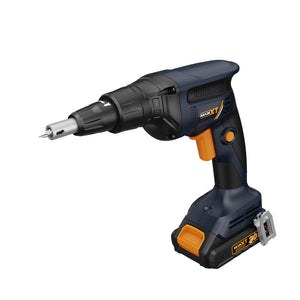
MAXXT Drywall Screw Gun
Complete your drywall toolkit with collated and manual screw guns.
View screw gun collection
The MAXXT 20V Cordless Drywall Sander delivers professional-grade specs at a DIY-friendly price — $189.99 with an 820W brushless motor, 99% dust collection, and just 7 lbs weight (MAXXT Product Page, 2026).
Key specs that matter for home projects:
| Feature | MAXXT 20V | DeWalt 20V DCE800B | Wen 6377 (Corded) |
|---|---|---|---|
| Price | $189.99 | $299 (tool only) | $149.99 |
| Weight | 7 lbs | 12.6 lbs | 17.4 lbs |
| Motor | 820W direct-drive | Brushless | 5-amp corded |
| RPM Range | 600-1,900 | 700-1,200 | 600-1,500 |
| Dust Collection | 99% (6-hole system) | Vacuum adapter only | Vacuum hose |
| User Rating | 4.6/5 (503 reviews) | 4.5/5 | 4.4/5 |
| LED Light | ✅ Built-in | ❌ | ❌ |
The built-in LED light bar is a small feature that makes a big difference — it illuminates the sanding surface so you can see where you've already sanded and where joint compound remains. The 0-150° adjustable head and extendable handle (up to 5.4 feet) mean you can sand ceilings without a ladder.
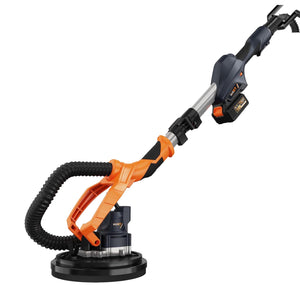
MAXXT 20V Cordless Drywall Sander
7 lbs, 820W brushless motor, 99% dust collection, built-in LED.
View product pageDon't just take our word for it. A professional finisher on r/drywall put it simply: "Next I bought the maxxt as it boasted being only 7ish lbs. Major difference with overhead work and I'm still using it for all my drywall jobs." That 7 lb weight — nearly half of what most corded sanders weigh — makes a real difference during ceiling work.
Verdict: MAXXT 20V offers the best weight-to-power ratio in its class, at a price 40% below DeWalt's equivalent.
Yes — modern cordless models like the MAXXT 20V deliver 820W of power, enough for sanding drywall compound, wood, and ceilings. Reddit users on r/Drywall and r/Dewalt consistently report completing entire rooms on a single charge with good results. Cordless is the recommended choice for projects under 50 sheets of drywall.
A 5Ah battery lasts 30-35 minutes at medium speed, enough to sand a standard 4×4 meter room (Bob Vila, 2026). Larger 6Ah+ batteries extend runtime to 45-60 minutes. Most DIY homeowners complete single-room projects within one battery charge. Investing in a second battery eliminates downtime.
Yes — drywall dust contains crystalline silica, which causes silicosis with prolonged exposure. NIOSH studies show drywall sanders can expose workers to dust levels 10 times the OSHA permissible limit. Always use a sander with dust collection and wear a NIOSH-approved N95 or P100 respirator.
Yes — most cordless drywall sanders include a dust bag and offer a shop vac adapter. The MAXXT 20V's 6-hole dust extraction system works with standard vacuum hoses and achieves 99% dust collection efficiency. A wet/dry vac with a HEPA filter is recommended for maximum dust control.
For beginners, cordless is the recommended choice — it's lighter, easier to maneuver, and eliminates the tripping hazard of extension cords. The MAXXT 20V ($189.99) offers excellent value with built-in LED lighting and 99% dust collection. Beginners should also invest in a half-mask respirator (not just a paper dust mask).
Corded tools typically last 15-20+ years with occasional home use (Fine Homebuilding, 2025). Cordless tool bodies last a similar duration, but batteries degrade in 5-10 years and cost $50-100 to replace. For occasional DIY use, the long-term cost difference is modest — roughly $160-170 for corded vs $340-440 for cordless over 10 years.
| Category | Winner |
|---|---|
| Power & Performance | Corded |
| Battery Life / Runtime | Corded (unlimited) |
| Dust Collection | Corded (99% vs 92%) |
| Weight & Ergonomics | Cordless (7-9 lbs vs 10-17 lbs) |
| Price (10-year cost) | Corded ($160-170 vs $340-440) |
| Convenience & Mobility | Cordless |
| Best for Home Projects (<50 sheets) | Cordless |
| Best for Large Jobs (>50 sheets) | Corded |
| Overall for DIY Homeowners | Cordless |
For the vast majority of DIY homeowners — those sanding single rooms, doing renovations, or tackling weekend projects — a cordless drywall sander is the better choice. The convenience of cord-free operation, the lighter weight for overhead work, and the ability to work anywhere without extension cords outweigh the power and runtime advantages of corded models.
If you're finishing a basement, remodeling a bathroom, or sanding a bedroom, a cordless drywall sander like the MAXXT 20V ($189.99) gives you professional-grade dust collection, 7 lbs of lightweight maneuverability, and enough battery life to finish the job.
If you're doing a whole-house renovation with 50+ sheets of drywall, keep a corded model on hand for the bulk work — and grab a cordless for the finishing touches.
MAXXT Drywall Sander Collection
Browse all corded, cordless, and pole sanders — built for smooth finishes.
View drywall sander collection


