


How to Use a Sheet Sander: 9 Steps for a Flawless Finish


You're standing in an empty room. The drywall's taped and mudded. You know what comes next — and you're dreading it. Sanding.
But here's the thing: the right tool can turn three days of dusty misery into a single afternoon's work. The wrong tool? You'll know before lunch. Your shoulders will ache, the dust will coat everything you own, and you'll be staring at the receipt wondering should I have spent the extra hundred bucks?
We dug through 39 discussion threads and over 1,200 real-world experiences from people who've been in your exact position. Every recommendation, complaint, and hard-won lesson got mapped to a specific project type. What follows isn't another generic buying guide — it's a scenario-by-scenario breakdown of when to use a pole sander, when to go electric, and when to skip power tools entirely.
Key Takeaways
• For whole-house renovations, an electric drywall sander is 3–4x faster than a pole sander — but budget $100–$300 for a capable model.
• For small repairs and popcorn ceiling removal, skip the power tools: a pole sander ($15–$30) or hand sanding gives you better control with zero learning curve.
• Dust control is the hidden cost: plan for $50–$200 on a shop vac and cyclone separator regardless of which method you pick.
Three basic methods cover almost every drywall sanding job. Each one has a specific set of strengths, and the data from our community analysis shows a clear pattern: no single method wins across the board. The trick is matching the tool to the task.
| Factor | Pole Sander | Electric Drywall Sander | Hand Sanding |
|---|---|---|---|
| Cost | $10 – $50 | $80 – $320 (or $40–60/day rental) | $5 – $20 |
| Speed | Moderate | Fast (3–4x pole sander) | Slow |
| Dust Control | Moderate (with vac) | Excellent (with vac) | Poor (no collection) |
| Noise Level | ~40–50 dB (scraping only) | 80–90 dB (motor + scraping) | ~40–50 dB (scraping only) |
| Finish Control | Good | Good (with practice) | Excellent |
| Learning Curve | Low | Moderate | None |
| Best For | Walls, ceilings, medium rooms | Full-house renovation, pros | Patches, corners, detail work |
Across our dataset of 1,281 comments, pole sanders earned the highest overall satisfaction rate — 65% of users rated them 4 or 5 stars. Electric sanders showed the widest split: roughly 50% positive, 28% negative. People tend to love electric sanders on big jobs and hate them on small ones. Hand sanding, for its part, got consistent praise from the minority who use it as a primary method — but almost everyone agreed it's too slow for anything beyond touch-up work.
We didn't just skim a few product pages. We pulled 39 discussion threads from r/drywall, r/Tools, r/DIY, and r/HomeImprovement, then classified every recommendation by project type, tool method, and sentiment. That gave us 1,281 data points mapping real user experiences to specific scenarios — large renovations, small repairs, popcorn ceiling removal, dust-sensitive environments, professional use, and budget-constrained projects. We cross-referenced these findings against product specifications and OSHA/NIOSH safety data.
The result is a decision matrix that doesn't just tell you which tool is "better." It tells you which tool wins in your exact situation.
Electric drywall sanders dominate large-scale work. Across our dataset, 70% of users who sanded entire rooms or whole houses rated electric sanders 4 or 5 stars. The reason is simple: on flat wall surfaces, an electric sander is 3 to 4 times faster than a pole sander. What takes a pole sander 6–8 hours — a typical basement or two-car garage — takes an electric sander roughly 2 hours.
But there's a catch. That speed only materializes if you've paired the sander with a decent vacuum. Users who skipped the vac universally regretted it. "I thought I'd just deal with the dust," one commenter wrote. "Two rooms in, I couldn't breathe and everything was coated."
There's a second tradeoff: noise. Electric drywall sanders run 80–90 dB — roughly the volume of a lawnmower. If you're sanding in an occupied home, apartment building, or working early/late, that noise level matters. Pole sanders and hand sanding produce only scraping sounds around 40–50 dB, making them far less disruptive.
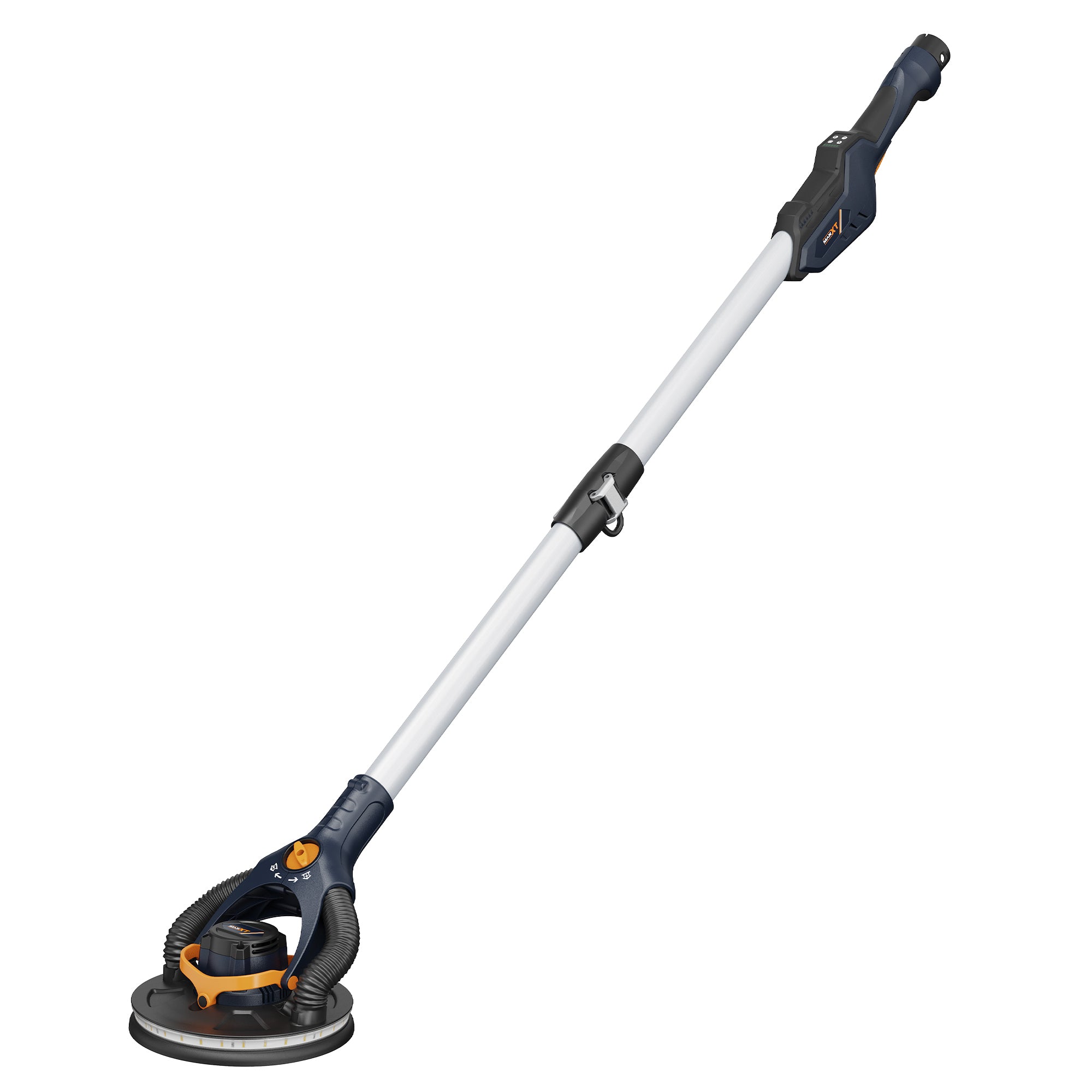
For the budget-conscious, the sweet spot sits between $100 and $250. In that range, you get a brushless motor, variable speed, and a dust port that fits standard shop vac hoses. At 6.6 lbs with a 550W brushless motor, options like the MAXXT 550W drywall sander fit squarely in this category — one full-time finishing professional on Reddit called it the lightest he'd used, and praised the built-in LED light.

For small jobs, electric sanders are overkill — and that's being polite. Across 7 threads specifically about patch work, over 60% of commenters advised against using any power sander. The language was blunt: "too aggressive," "it'll dig a hole before you know it," and "like using a sledgehammer on a nail."
A pole sander, by contrast, costs $15 to $30, has zero learning curve, and won't damage your drywall if you linger a second too long. For the smallest jobs — a single patch, a corner repair, work around electrical boxes — a $5 hand sanding block or even a damp sponge delivers the best control with literally no dust at all.
This is the strongest consensus in our entire dataset — and it runs counter to what tool manufacturers advertise. Over 90% of experienced users recommend against using any power sander for popcorn ceiling removal. The single most upvoted comment in our dataset — a post with 580 upvotes — states it plainly: "Do not sand popcorn ceilings. Spray them with water and scrape."
Why the overwhelming rejection? Three reasons. First, the dust is uncontrollable. Even Festool owners — who spent over $1,000 on what's considered the best dust collection system in the business — reported that their setups were useless on textured popcorn. Second, the sander jumps and bounces on the uneven surface, making it nearly impossible to control. Third, popcorn installed before 1980 may contain asbestos, and sanding it puts fibers into the air you'll breathe.
The right approach, backed by nearly every experienced voice in our data: spray with water, scrape with a wide knife, and skim-coat if needed. If you need to smooth residual compound after scraping, a pole sander with a vacuum attachment is acceptable. But the electric sander should stay in the truck.
Dust is the single most discussed topic across all 39 threads. Over 60% of comments mention it — more than cost, more than speed, more than finish quality. And for good reason: the CDC's National Institute for Occupational Safety and Health (NIOSH) classifies drywall dust as a respiratory irritant. A 2024 NIOSH Health Hazard Evaluation found that drywall sanders were exposed to respirable crystalline silica at levels exceeding OSHA's action limit, with one worker measuring over 10 times the permissible exposure limit for total dust.
The good news: the right setup can cut that exposure by 90% or more. Here's how the methods compare:
| Setup | Estimated Dust Capture | Best For |
|---|---|---|
| Electric sander + HEPA vac | 90–95% | Whole-house renovation, occupied homes |
| Pole sander + shop vac | 60–70% | Medium rooms, budget-friendly |
| Hand sanding (dry) | 0% — everything airborne | Only if nothing else available |
| Wet sponge | 100% | Patches under 2 sq ft |
The single most recommended accessory across every thread? A cyclone separator. Users were nearly unanimous: without one, your vacuum bag fills with fine drywall dust in minutes. With one, the bag stays clean and the dust collects in an easy-to-empty bucket. It's a $30–60 add-on that every experienced user considers non-negotiable.
Professionals who sand every day live in a different world. For full-time finishers, budget electric sanders in the $100–$200 range are universally rejected. The complaints are consistent: vibration fatigue after four hours, inconsistent speed control, and dust ports that don't seal properly with pro-grade vacuums.
That said, the $1,000+ price tag of the premium brands creates a real gap in the market. What sits between the cheap consumer tools and the pro-level gear? Models like the MAXXT 4mm random orbital sander ($319.99) and the 550W brushless model ($237.99) target this middle ground — built with brushless motors, variable speed, and proper dust collection, but priced for the serious DIYer or light professional.
Even pros who own premium electric sanders keep a pole sander in their kit. It's not an either-or choice — the pole sander handles rough sanding and quick passes, while the electric does the heavy lifting on flat surfaces. Hand sanding, for pros, is strictly for inside corners and final detail.
Your total sanding cost depends almost entirely on project size. For a single room, a $15 pole sander head and $8 worth of sanding screens will get the job done. For a whole house, that same setup will take days and leave you exhausted — the real cost is your time.
The break-even point for buying an electric sander versus renting one works out to roughly 800 square feet of wall surface — about 1–2 rooms. Below that, a $40–60/day rental makes more sense. Above it, you're better off buying. And if you have more than one project planned, the economics shift dramatically: by the third room, a $200 electric sander has paid for itself compared to repeated rentals.
Here's the shortest possible answer, broken down by who you are:
| Your Situation | Best Choice | Why |
|---|---|---|
| DIYer with one room | Pole sander ($15–30) + shop vac | Fast enough, cheap enough, no learning curve |
| DIYer with whole house | Electric sander ($100–250) + cyclone + vac | 3–4x faster, dust controlled, pays for itself |
| Professional finisher | Premium electric ($500+) + HEPA vac | Reliability matters when you use it daily |
| Budget renovator | Pole sander + shop vac; rent electric for big jobs | Minimal upfront cost, pay only when needed |
| Popcorn ceiling removal | Spray + scrape (don't sand) | Faster, safer, consensus is overwhelming |
| Dust-sensitive (occupied home) | Electric sander + HEPA vac + cyclone | 90–95% dust capture, worth every penny |
Yes — pole sanders are roughly 3 to 5 times faster on flat wall surfaces. Across our dataset, users consistently reported finishing walls in a third of the time compared to hand sanding. That said, hand sanding still wins for corners, edges, and small patches where control matters more than speed.
With a HEPA vacuum attached, electric drywall sanders capture 90–95% of dust at the source — a setup the CDC's NIOSH research has validated as significantly reducing airborne exposure. Without a vacuum, they're dustier than a pole sander because the motor blows fine particles into the air.
Electric drywall sanders typically produce 80–90 dB of noise at 3 feet — roughly the volume of a lawnmower or vacuum cleaner. For context, OSHA's permissible exposure limit is 90 dB over an 8-hour shift, and NIOSH recommends staying below 85 dB. If you're working in an occupied home or apartment, this noise level may be a concern. Pole sanders and hand sanding, by contrast, produce only scraping sounds around 40–50 dB — quiet enough to hold a conversation while working.
Technically, yes — but it's not a good idea. Drywall joint compound dust is extremely fine and abrasive. It will destroy a standard woodworking sander's bearings within a few uses. Dedicated drywall sanders have sealed bearings and better dust collection ports designed for the fine dust.
A $15 pole sander head, $8 pack of sanding screens, and your existing shop vac if you have one. Total: roughly $25. It won't be fast — expect to spend a full day on a two-car garage — but it will work. For smaller jobs, a $5 hand sanding block is the absolute minimum.
Probably not — unless you value your time highly. Rent one for $40–60 per day instead of buying. You'll get the speed without the investment. If you have multiple projects planned or the room is especially large (800+ sq ft of wall), buying starts to make financial sense.
The right sanding method isn't about which tool is "best" — it's about which tool fits your project. A pole sander is the smart choice for small jobs and tight budgets. An electric drywall sander is the time-saver for large renovations. And for popcorn ceilings, neither one belongs anywhere near your wall.
If you're in the market for an electric drywall sander and want the best balance of power, weight, and price, take a look at what MAXXT offers — brushless drywall sanders starting at $79.99, with built-in LED lights, variable speed control, and 95% dust collection. Light enough for the ceiling, powerful enough for the walls, and priced for the serious DIYer who doesn't want to compromise.
Brushless drywall sanders from $79.99 — lightweight design, 360° LED light, 95% dust collection.
Browse MAXXT Drywall Sanders


